
(No reproduction of this material can be used without permission)
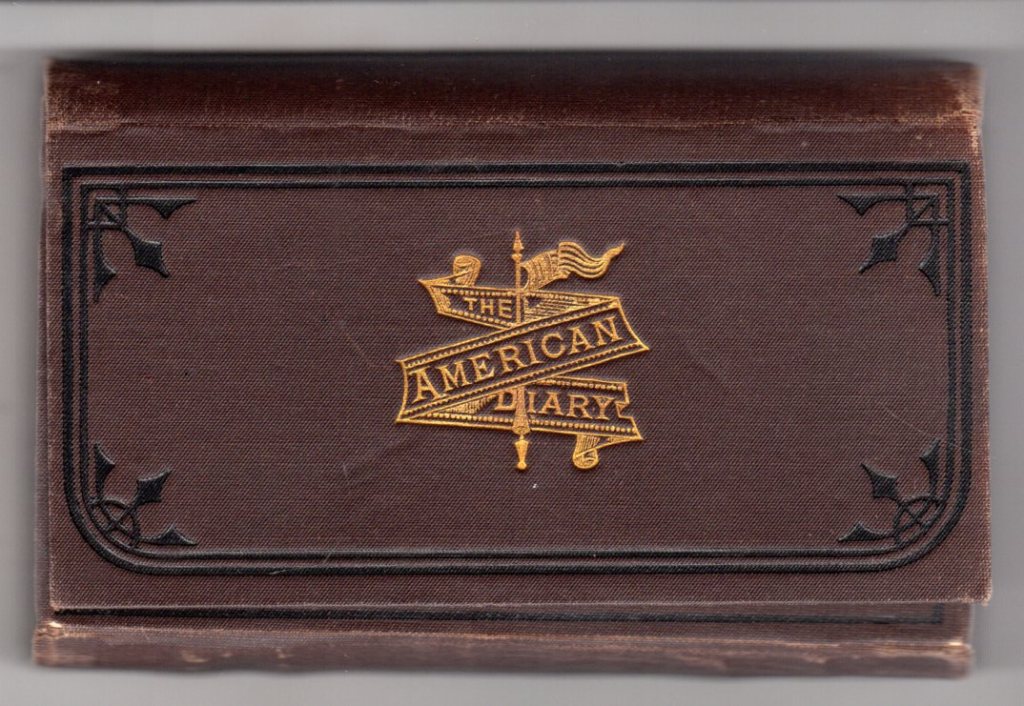
By the time this diary was written in the 1890’s, our author Clara E. (Kingsley) Brockway was a 51 year old widow. Clara had two sons; Albert, who became a famous architect and Howard, who became a noteworthy musician and composer.
This diary represents 2 separate trips to Europe, one in 1892 and one 2 years later in 1894. Howard, Clara’s youngest son, had moved to Berlin Germany and was studying under the guidance of Professor Otis B. Boise, so because of this, his mother Clara had a chance to visit and stay a few months abroad with him. They actually stay in a small quaint little village not far from Berlin, in Poland, called Schreiberhau.
Professor Boise had a daughter Anabel who was 23 at the time and was an accomplished singer. Howard must have been quite smitten with Anabel because 4 years later on February 15th, 1896, Howard and Anabel married in Lake Wood Ocean New Jersey. But that precious marriage would only last 6 years. Anabel would become seriously ill, which led to a deep depression, and on September 27th, 1901, she killed herself by throwing herself off a moving train. And Clara, the author of this diary, was on that train with her. (I found the actual newspaper article that tells all about this terrible tragedy and I’ve included it here. But please note, it is not for the faint of heart).
These two trips, which Clara writes about in her diary, not only give the reader a look at what life was like living abroad in Europe over 130 years ago, but it also gives the reader some insight as to what life was like on board a steamship (4 steamships to be exact) sailing the wide expanses of the ocean, including seasickness, deaths at sea, rats on board the ship, afternoon tea in her deckchair and so much more. It’s really quite the adventure.
The parts that really tugged at my heart is how close she was with Anabel and how many summer days were spent in hammocks while Howard her son would read aloud to them all. Then during the evenings, Howard would play the piano while Anabel sang. And to think, only 6 years later, that terrible tragedy would occur.
Before I quote from the diary itself, I want to give you a little more of an in depth description of our cast of characters because it really does help to make the entries come alive. Lets start with our author of course….
Clara E. Kingsley Brockway
Taken from her Obituary in The New York Times. June, 24th, 1914.
Mrs. Clara E. Kingsley Brockway (1841-1914) who was one of the first woman stenographers in this country, died yesterday at her home at 317 West Ninety-second Street. She was born in Syracuse in 1841 and married to Leverett E. Brockway of Brooklyn. Upon his death in 1876 she took up the study of shorthand and was first employed in the law offices of Mann and Parsons. In 1888 she became stenographer to the United States District Court, and held that position in the Southern and Eastern District Courts until her illness this summer. She is survived by two sons, A. L. Brockway, an architect of Syracuse, and Howard Brockway, musician and composer.
____________________

Albert L. Brockway (1864 – 1933) earned his education at the Polytechnic Institute in Brooklyn, then studied architecture at L’École des Beaux Arts in Paris. Brockway served as a professor of architecture at Syracuse University from 1893-95 and went on to practice architecture in New York. He served as consulting architect for the New York State Agricultural College at Cornell and the State Capitol in Albany. Brockway joined the New York State Board of Examiners for the Registration of Architects upon its creation in 1915 and served until his death in 1933.
____________________

Howard A. Brockway (1870 – 1951) Brockway was born on November 22, 1870, in Brooklyn, New York. He spent five years in Berlin, studying composition under Otis Bardwell Boise and piano under Heinrich Barth. Afterwards he returned to the U.S. and worked as a piano teacher and composer at the Peabody Institute in Baltimore, Maryland, along with the Institute of Musical Art (now the Juilliard School) and the Mannes College of Music, both in New York. Some of his pupils included Eugene Bonner, Eva Clare, and Anne Stratton.
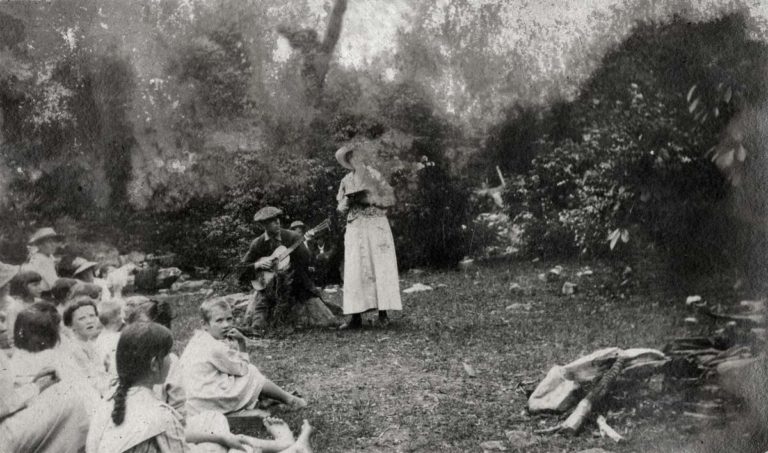
Collaborating with the classically-trained singer Loraine Wyman, he carried out a six-week fieldwork journey in the Appalachian Mountains in Kentucky to collect traditional folk songs from the people living there. Photo from Pine Mountain Settlement Website
Brockway recorded the tunes (and later wrote piano accompaniments), while Wyman recorded the words. They published their work in two volumes, which appeared in 1916 and 1920. Brockway’s own compositions include a symphony, a suite, a symphonic ballad, a piano concerto, chamber-music works, choirs, and songs. He died on February 20, 1951, in New York.
____________________

His obituary In the Boston Evening Transcript. December 3rd, 1912. Professor Otis Bardwell Boise (1845 – 1912), Head of the department of composition at the Peabody Conservatory of Music in Baltimore, and prominent in that city’s musical circles, died at his home there on Monday afternoon. He was born in Oberlin, Ohio, in 1844 and studied under noted masters at Lepsiz and Berlin, and for many years was a teacher of harmony and composition in New York Conservatory. In 1901 he joined the faculty of the Peabody Conservatory. He was the author of “Harmony Made Practical” and “Music and Its Masters.” He had composed symphonies, cantatas and other works. Professor Boise was a close friend of John D. Rockefeller and every winter they played golf on the links near Augusta, Ga. He is survived by a wife and four daughters.
____________________

Anabel Boise Brockway (1869 – 1901)
“Published in the Evening (New York, N. Y), 27 Sep 1901, pg. 5.
“Death Leap From A Car. Beautiful Mrs. Brockway Jumps from Express in Dark Tunnel. Mangled By Two Trains.
Accomplished Young Woman on Way Home Commits Suicide While Insane.
Mrs. Anabel Brockway, who killed herself by leaping from the Southwestern limited train of the N. Y. Central Railroad yesterday, was brought to N. Y. from Croton this morning. It (her body) was taken to the splendid Brockway home at No. 317 West Ninety-second street, where it will be until buried, the pitifully mangled relic of a woman who had beauty and wealth and love, but longed in vain for the greatest boon of all – health.
She was the wife of Howard Brockway, the noted musician and composer, who has a studio in the Carnegie Building. They were married six years ago and one child was born to them – a girl, Sylvia, who is now four years of age. Mrs. Brockway was the daughter of Prof. Otis Boise, for many years connected with a school of music in Berlin and now a Professor of Harmony in Peabody Institute, Baltimore.
The young wife suffered for years from an ailment that caused mental irresponsibility at times. The summer just past she spent with her husband, her mother-in-law, Mrs. Clara E. Brockway, and her ten-year-old sister, Helen Boise, at Bridgewater, N. Y. Her condition appeared to be much improved and a start was made for home yesterday.
All of the party with the exception of Mr. Brockway, who was visiting near Auburn, rode in a stateroom on a sleeping car which was attached to the rear of the Southwestern Limited at Utica. This car was the last one in the train and the stateroom was in the extreme rear of the car. Thirty-five miles north of this city, near the little station called Crugers, there is a tunnel cut through the rocks. It is not a long tunnel, so the cars are not lighted, and while running through, the trains are in total darkness.
When this tunnel was reached yesterday afternoon the elder Mrs. Brockway and her daughter-in-law were the only occupants of the stateroom. When the train emerged into the light of day the elder Mrs. Brockway was the sole occupant of the room. The daughter-in-law had disappeared as thoroughly and as noiselessly as had the darkness.
Filled with apprehension Mrs. Brockway hurried through the car. None had seen the young wife of her son. She called the conductor, who sent a telegram back to Croton Landing to look for the body of a woman who had leaped from the rear platform, for it was not deemed possible that Mrs. Brockway would survive a fall from a train going nearly sixty miles an hour.
Closely following the train from which Mrs. Brockway leaped came a second section, traveling at high speed. The engineer of this train saw a body on the track as he entered the Crugers tunnel. It was too late to avoid striking it, and young Mrs. Brockway, who, doubtless was already dead, was ground to pieces under the wheels.
The first train did not stop until it reached 125th street. There the conductor received a telegram from the conductor of the second section telling of the sorrowful circumstances surrounding the finding of the body. . . . . . . . . Telegraphic advice’s from Saranac Lake indicate that Miss Boise, a younger sister of the dead woman, who is at that resort, is at the point of death and scarcely can live through the day. She is suffering with tuberculosis and worriment over her condition had much to do with the sad mental trouble of Mrs. Brockway.”
____________________
1892 FIRST TRIP
“July 6th, Sailed 3 p.m. for Liverpool on City of Berlin. Glorious day. Slept well.”
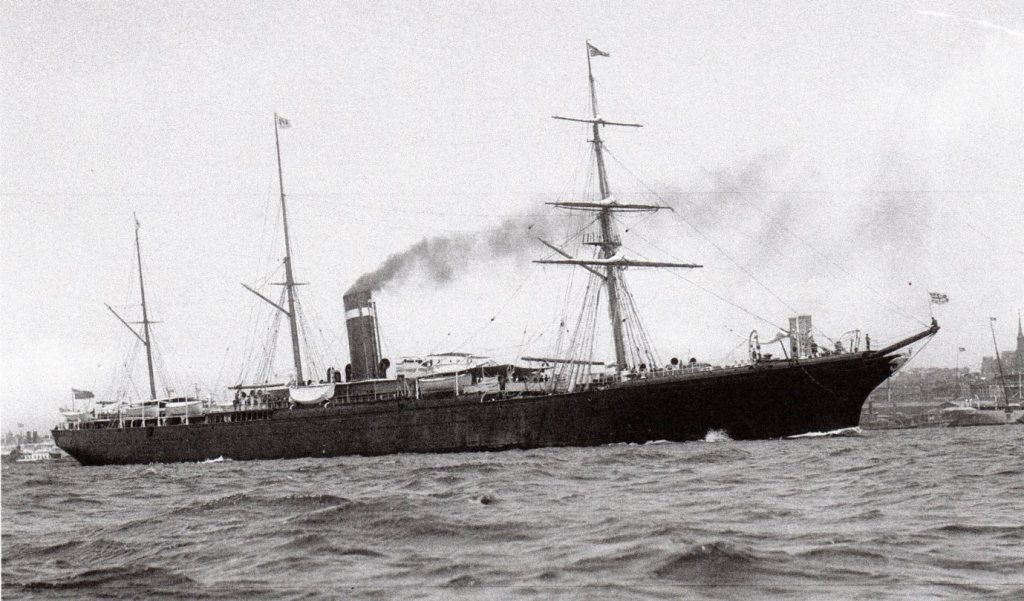
“July 8th, Ship plunging. Sick. Dressed and sat on deck in pouring rain. Sea so grand, even nausea could not break its charm. Saw flying fish washed aboard. Storm abated in forenoon. Sun shone. Sick now and then until late p.m. Well before bedtime. Slept fine.”
“July 11th, Clear and cooler. Burial at sea. A steerage passenger – man; all alone. Steamer homeward bound passed. Fog again p.m. Whistles. Dense all evening to midnight and probably all night.”
“July 12th, Dense fog. Whistle every minute should think. Clearer in p.m. and rougher. Concert in evening. Walked 16 times around deck. Miss A. saw whale spout. I just missed it. Saw ship way off to our port going as we were.”
“July 14th, Clearer, bright sun and blue sea. Cloudy before noon. Wind increased and heavier sea. Rain. Just after dark Majestic passed about a mile and a half on our port, homeward bound. She burned green lights in reply to our red, white and blue.”
“July 15th, Fastnet sighted 5 a.m. Cloudy gray and damp. At 9 a.m. tender came alongside and took off 30 odd passengers for Queenstown. Saw City of Chicago plain. Cut in two just forward of smokestack. Cunard Boston Steamer passed between us and Ireland bound out to America.” (She arrives in Liverpool the next day and is greeted by Howard whose on the dock waiting for her. They head to Chester to spend the night. Then it’s on to Leamington where they are staying at the “Richmondville” proprietor Mr. Fenton.)

“July 19th, At 10:35 took train to Stradford-on-Avon. Visited Shakespeare’s House and Church where buried &c. Pouring rain all day. Returned to Leamington. At 5:30 left Leamington for Oxford. Arrived about 7:12. Stopped at “The Mitre” – a quaint rambling old inn part of it standing since Chancer’s time. Excellent table and service; fine old silver.”
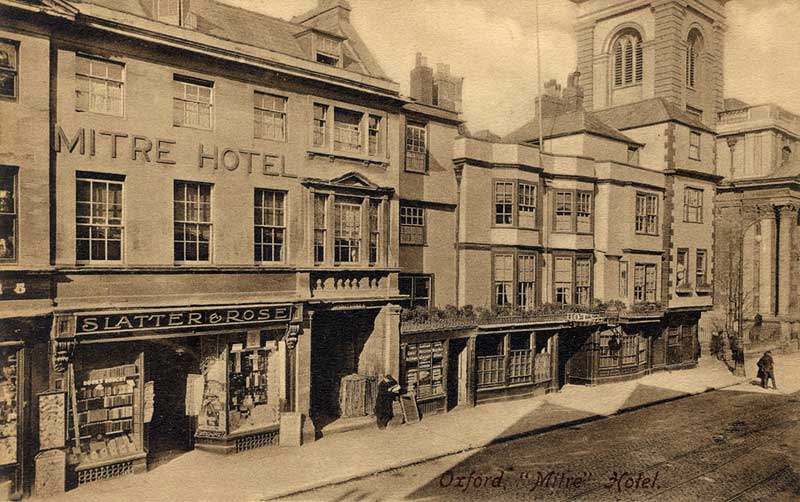
(She’s in London on the 20th and takes a steamer up the Thames River. Spends a good deal of time at the National Museum. Then by the 23rd she’s on a train to Harwich and then boat to Hamburg, Germany)
“July 25th, Arrived at Hamburg about 1:30 a.m. Left boat about 6:30. Went to Hamburg Hotel, took room and had nap. Ate decent lunch and walked to Hamburg Packet Office. Engaged passage home on Augusta Victoria for Sept. 16. Went on to station and at 12:35 took train for Berlin arriving at 5 p.m. Found lovely accommodations at 15 Luther. Saw Frau Janaska and Fraulain Tosia and youngest. Went out to dinner. Took car ride and called on Mr. and Mrs. Nevin. Charming city! Home and to bed.”
“July 26th, Berlin. Howard and I breakfasted alone, cozy as could be. He played to me until noon. Then he took me through beautiful parts of the city, past Thier Garden (she means Tiergarten), through Unter den Linden past old Frederick the Greats statue, old Palace, the Kaiser’s Schloss, the Dom to the old Gallery. Saw Murillo’s “St. Anthony and Christ Child” and a fine Velazquez near it (a pompous fat old man). I don’t wonder he likes it here, it is charming. After supper went to Zoo Garden. Double band concert.”
(The following website has incredible original photos of Berlin in the 1890’s)
https://monovisions.com/vintage-historic-photos-of-berlin-germany-circa-1890s-19th-century/
“July 27th, Took train 9 a.m. for little town of Greisweld (Greifswald) where we arrived about 2. Had car to ourselves and rode through most beautiful country, stopping at such charming little resorts. Fields of blue Bachelor Buttons and Poppies. Stood each at open window for miles riding thru pine woods, sweet odors! G. is a quaint place, with old houses. Took steamer and had 2 ½ hours on the Baltic, smooth and bluer than sky. Stopped at Lauterbach then at Kleinhagen. Mrs. Boise and Anabel on dock. Long ride over wild flowers, thru little fishing village to Boise Cottage to supper. House trimmed with flowers. After supper walked on beach then to rooms at hotel.”
“July 29th, Mr. Boise, Anabel, How’d and I took long walk up through woods to pilot station and around. Such views!! Afternoon coffee in the woods by the Wellmann’s overlooking the sea. Dance at hotel by the Howe’s in evening. Music by young Schelling, singing by Mr. Dyer, Anabel. (father accompanying).”
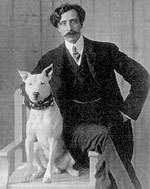
Ernest Schelling was born in Belvidere, New Jersey, July 26, 1876. Schelling was a child prodigy. His first teacher was his father. He made his debut at the Academy of Music in Philadelphia, Pennsylvania, at age 4. At age 7, Schelling traveled to Europe to study. He was admitted to the Paris Conservatoire. While in Europe he worked with many great masters including Percy Goetschius, Hans Huber, Richard Barth, Moritz Moszkowski and Theodor Leschetizky. At the age of 20 in 1896, he began studying with Ignace Paderewski and was his only pupil for three years. He toured Europe and North and South America, gaining a reputation as a remarkable pianist.
“July 31st, Anabel and I walked over to Klein Zicker and through its cute little one street to the sea. Sat on the beach and she read Chadwick’s poems aloud (“Out of the heart”). Howard was playing tennis. Picked each new kind of wild flowers on the way and had 23. Dined at the Arnold’s cottage – we three.”
“August 2nd, At 10 a.m. bade adieu to Miss Brewster and the Misses Johnson. Charming people. Sorry have them go. They sail for home on Oordland Aug. 15. Glorious surf and white capped sea! Down on beach after supper to watch it. Saw fisherman take down bath-house and prepare for worse storm (which did not come.)”
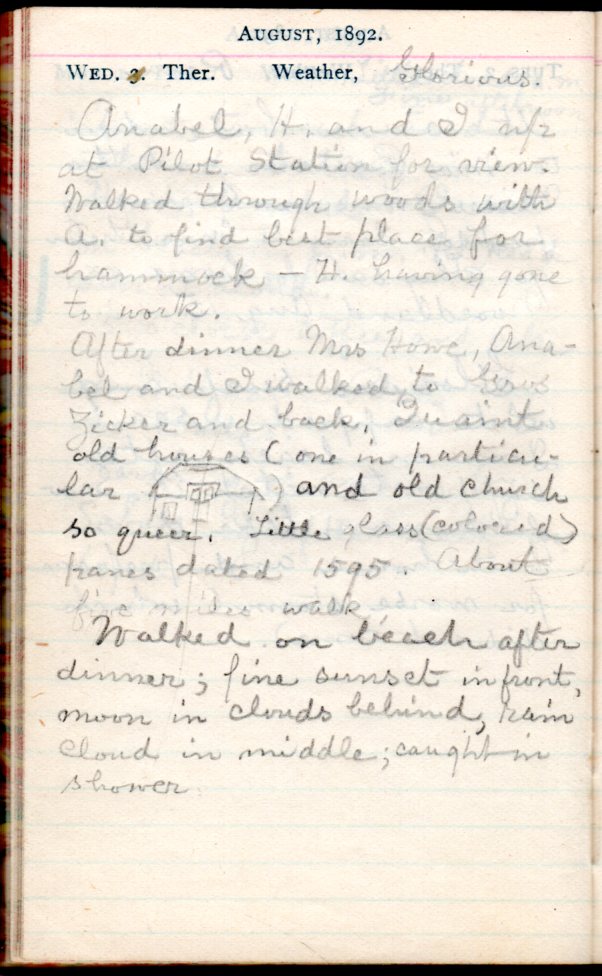
“August 3rd, Anabel, H. and I up at Pilot Station for view. Walked through woods with A. to find best place for hammock. H. having gone to work. After dinner Mrs. Howe, Anabel and I walked to Gross Zicker and back. Quaint old houses, one in particular (she then has a little drawing, shown below) and old church so queer. Little glass (colored) panes dated 1595. About five miles walk. Walked on beach after dinner; fine sunset in front, moon in clouds behind, rain cloud in middle, caught in shower.”
(Next few days are rather leisurely, more reading aloud by Howard, lounging in the hammock and walks in the village)
“August 7th, All p.m. out in hammock with Mrs. Boise, she reading Isaac Taylor’s work of 100 years ago, last edition 1853. Beautiful moonlight evening. Walked on beach and had interesting talk with Mr. Willard. Saw lunar rainbow.”
“August 8th, Read all a.m. in room. In hammock all p.m. Mrs. Boise with me. Down on beach in evening. Sea without a ripple, of leaden blue, meeting horizon so could scarcely tell where one ended and other began; this was off to the east. Sunset glow covered the Western sea for miles, coloring it rose. In center, off from shore a good distance, half dozen fishing yachts at anchor, masts and all reflected on the water. Soon, out of the sea in the east, peeped the moon and as she rose make a path of light on the sea right to us. Grand! Sat on little dock for hours, air mild.”
“August 10th, Took sail for Gohren early in a.m. Mr. and Mrs. Boise, Anabel, the Japanese, Mr. Willard and young Howard Baylis. Anabel so seasick. We three women did not return by boat. Had dinner at hotel. Went on beach and in woods. Glorious old woods just back of beach. G. is quite a place – hills and valley’s. We walked home (5 miles) over meadows and on beach. High wind. Country most beautiful. Stopped at Lobbe to rest and had coffee. All three climbed up in a fine old apple tree once and rested. Jolly day!!”
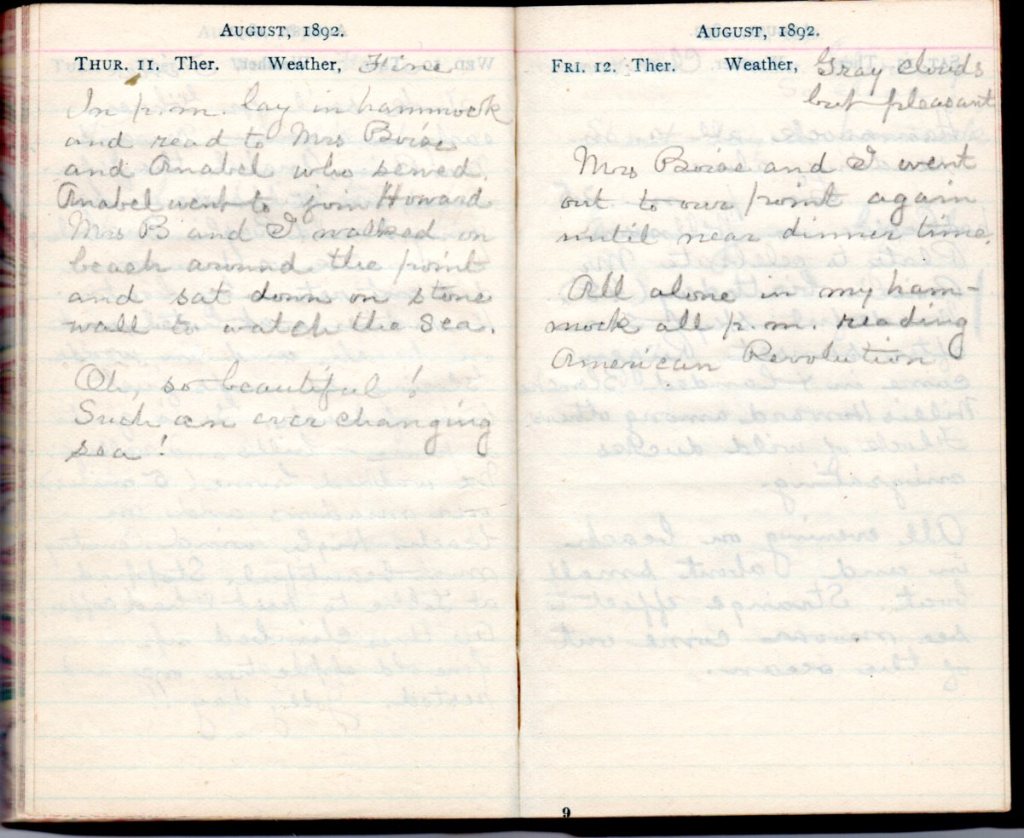
“August 13th, Hammock all a.m. reading alone. In p.m. 25 had coffee in Wellman. Platz to celebrate Mr. Boise’s birthday (48). Wonderful sky and sea after sunset. Rugen came in and landed. Blanch, Willis, Howard among others. Flock of wild ducks migrating. All evening on beach in and about small boat. Strange effect to see moon come out of the ocean.”
“August 15th, Hammock reading. Marvelous sunset! Great winged clouds from horizon in S.E. to Zenith tinged from sunset color. Colors last so long here! Walked on beach until late then music and singing. Procession of soldiers in sky, poor Augusta said meant war to be declared in 2 days. Her lover a soldier.”
“August 17th, Isaac Taylor’s birthday (1787). Hammock. Another fine sunset while watching tennis out on meadow. What a view! We seemed in center of world with immense space all around, low hills against horizon. Dance for Germans at hotel in evening. (Ice Cream)”
“August 19th, Very light showers but not to keep us in house any. Hammock and in sand-hole again. Oh, what colors on the sea at sunset! And what a glorious sunset – deep read and peculiar green! This is bewitching country. Young people played whist (2 sets) all evening out on Boise porch.”
“August 20th, Dance for peasants on the green in the evening given by Mr. Arnold. Remarkable gathering of sturdy men, women and children, all of whom dance so well. Band for music. Pretty sight. Chinese lanterns, fireworks, German and American flags.”
“August 22nd, Weather Glorious. Mrs. Boise and Frieda left this a.m. and make a big gap in the circle. Poor Frieda! This is her first step out into the world from such a family group as I never saw before.”
“August 25th, Hot in sun. Lovely shade. Hammock &c. Mabel joined Anabel and me. Howard later – work. We hotel Americans had the balance of the “colony” at supper with us – 25 in all. Table looked fine. An auction sale of packages after supper, dancing and progressive euchre. (Little bags of stones for money given to each).”
“August 28th, Cloudy and high wind. Had a delightful afternoon in hammocks. Anabel and I while Howard read aloud. Then H. and I went down on the beach. Half the sea dark blue and gray, the other half like moonlight. Woods looked beautiful from beach, different shades of green. Evening walk on beach, fine, water so low because of wind from west.”
“August 29th, Glorious but high wind still. Read in hammocks in a.m. and lay in sand holes on beach all p.m. Beautiful to watch the sea. I read aloud Mrs. Wilkins “A Gentle Ghost.” In evening played letter game in Mrs. Bolt’s. Watched glorious sunset over an hour, making a sea of flame!”
“August 31st, Glorious sunset, the beauty of them here lasts over an hour. They change in form and color and make such glows all around the sky and reflect on the sea. Watched this one over an hour, going from one end of hall to the other to lose none of the effects. Mabel came way up to summon me, fearing I would lose some of it.”
“September 4th, Bowels decidedly out of order so kept my room and lay quiet. Anabel and Howard with me all p.m. The latter finished reading aloud, “Little Minister.” Haven’t been so intensely interested in a book for years. Consider it a fine novel.”
“September 6th, So clear and such fine clouds; just warm enough. Went down to coffee and ate on piazza – all of us. At cottage a while in a.m. Not quite well – weak – but gaining. Anabel and Howard in my room in p.m. Latter reading “A Window on Thrums.” Another gorgeous sunset!! Wish I might forever remember its distinctive features – the long narrow bands of color.”
“September 7th, Cloudy, cooler but balmy. Better and decided to leave with rest of Americans at hotel instead of remaining at most three days more. Helped Howard pack and did some for myself. Anabel, Howard and I had an afternoon of music to ourselves. She sang lovely, his songs among others. He played lot of his compositions of past winter, some of them very beautiful, especially “Eliason” and seem worthy of publication.”
“September 8th, Cloudy, mild and landscape bewitching in the shade. All fourteen (8 from hotel and six from cottage, the Botts and Miss Coverly) left at 6 a.m. by wagons for Klein Hagen. Anabel rode over with us. Dear girl, how I love her and how sad I am to leave her!! Took boat Anklam at K. H. for Lauterbach, thence train to Sralsund (Stralsund) where we visited an old church (1300). Saw some quaint old houses. Dined at Golden Lion and at 4 p.m. left for Berlin. Rained nearly all time in S. and showered all way to B. Such fun! We filled 2, 3rd class coupe’s. Played whist, sang &c. Arrived 8:25 and at 15 Luther, safe, 9:05. Fine weather.”
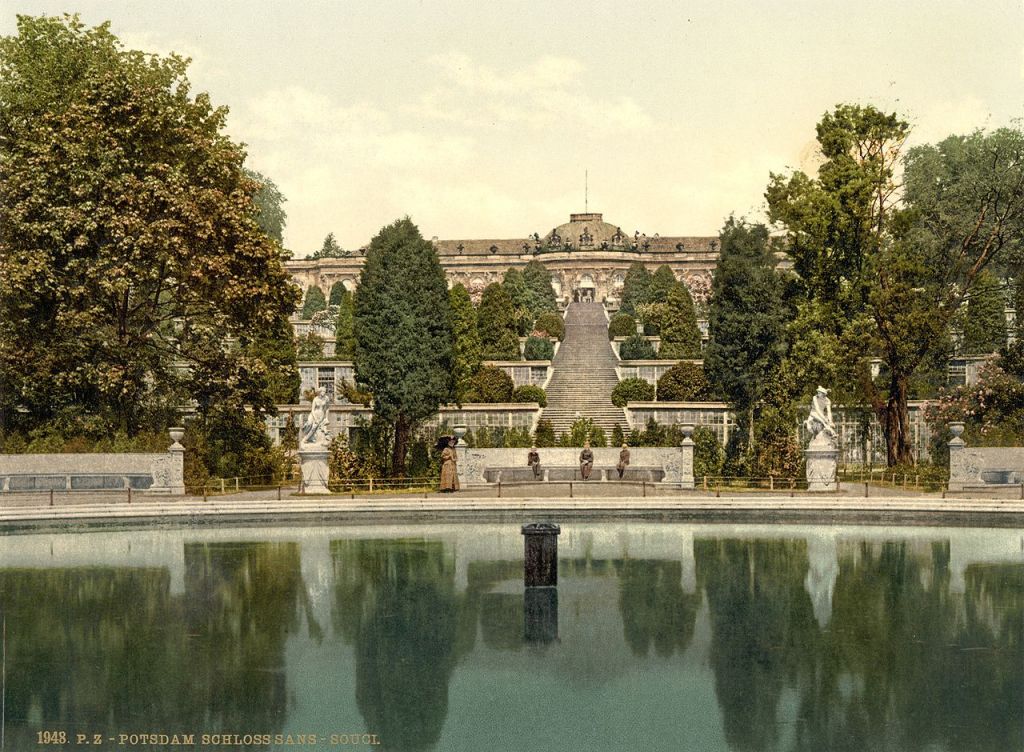
“September 10th, At 10 a.m. Howard and I took train to Pottsdam. Drove about and visited Babelsberg (the beautiful little palace of Emperor Wm. Saw his room as he left it). Sans Souci, went past the Noyer Palace (present Emperor’s) and to the church were is the tomb of Frederick the Great. Sans Souci was his palace. Took tea at Mrs. Boise’s. Anabel at home, came tonight 5:10.”
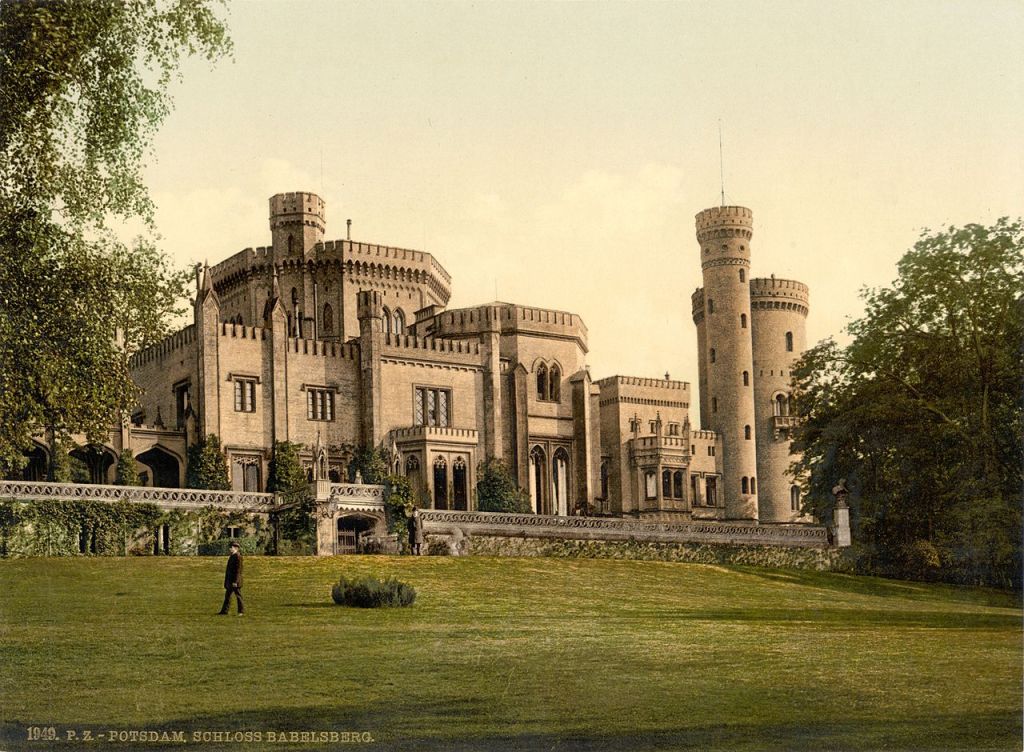
Babelsberg Palace
Sans Souci Palace
“September 11th, Pleasant but in p.m. very light showers. At 11:45 went to Herr Barth’s and had pleasant call with him, his mother and sister before recital. Barth (another very famous pianist) played for two hours. He is a great artist, that is a fact. I like him better than D’Albert. After dinner called on Mrs. Nerin and Mrs. Baylis with Mrs. Boise, Anabel and Howard. Tea and evening at Mrs. Boise’s.”
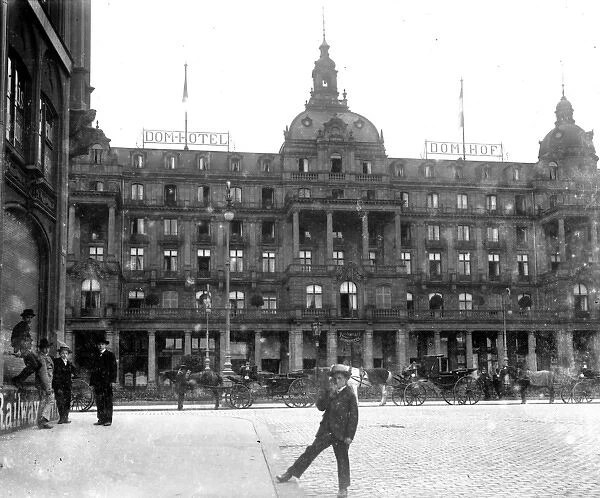
“September 14th, Dined with Boise’s at restaurant for last time. Left for Cologne, Howard and I at 1, arriving at 10. Stopped at Dom Hof. Nice house and slept well. The country between Hildesheim and Cologne very beautiful, quaint little hamlets and streets set down in romantic spots. Passed one grand castle set in the woods on steep hill – Marienburg – of House of Brunswick, now run out. Saw hedges cut in figures. Had coupe to ourselves. Meals on train (2nd class.)”.
(The link below is a fabulous website all about Marienburg Castle which states that is is the largest fortress ever built in Europe.)
https://edsimoneit.blog/2019/01/14/marienburg-castle-is-the-largest-fortress-ever-built-in-europe/
“September 15th, Had such a lovely day with my blessed boy, so dear to me. Our last one of many! He took me at once to cathedral, during service. Visited it 3 time and walked around outside. Grand beyond all I ever saw of course. Went through museum and saw portrait of beautiful Queen Louise. Bought a photo of it. After dinner we strolled about seeing sights. Then in his room I lay on bed and he read to me from “Across the Plains.”
(I believe she’s talking about the 1892 book by Robert Lewis Stevenson. Across the Plains (1892) is the middle section of Robert Louis Stevenson’s three-part travel memoir which began with The Amateur Emigrant and ended with The Silverado Squatters. The book contains 12 chapters, each a story or essay unto itself. The title chapter is the longest, and is divided into 7 subsections. It describes Stevenson’s arrival at New York as an immigrant, along with hundreds of other Europeans, and his train journey from New York to San Francisco in an immigrant train. Stevenson describes the train as having three sections: one for women and children, one for men, and one for Chinese. He notes that while the Europeans looked down on the Chinese for being dirty, in fact the Chinese carriages were the freshest and their passengers the cleanest.”)
(Clara arrived in Ostend early the next morning and took the train straight for London where she caught the ship, “Augusta Victoria” and sailed at 12 on the 17th of September)
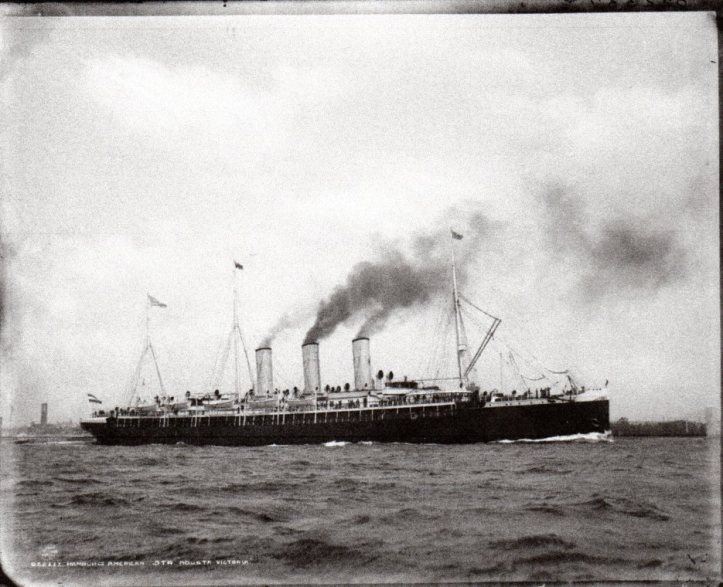
“September 18th, Water rough. Gale. Sick. Spent a.m. on Mrs. M.’s lounge in officer’s room until 1 o’clock when commenced throwing up so took to chair on deck until bed time. From awful stuffy.”
“September 20th, Clear until noon but still a gale and heavy sea. Toward night sky looked angry and sea washed over bridge and officers. Stayed in my chair under boat until deck so wet all were driven in. Ports all closed. Water had washed in ventilation. Room awful! We ran into thunder storm. Thought at first boiler had burst. Not at all afraid. Trusted ship and commander.”
“September 21st, Clear and cold. Iceberg near maybe. In chair on deck until frozen in about 5. Room more endurable. Managed to live through another night. (Passing tramp signaled to know if we saw an iceberg.)”
“September 23rd, Charming and little cooler. Took all meals in saloon, first since day of sailing. Sea like a mirror. Clouds on very edge of horizon looking like land, Wonderful! Saw four great whales in quick succession close on port side. Passed two schooners and French Steamer. Small vessel (whaler?) on port side.”
(She arrives in New York the next day. The diary then skips a few pages and when the writing starts back up, Clara has started a new adventure, only this time it’s the summer of 1894.)
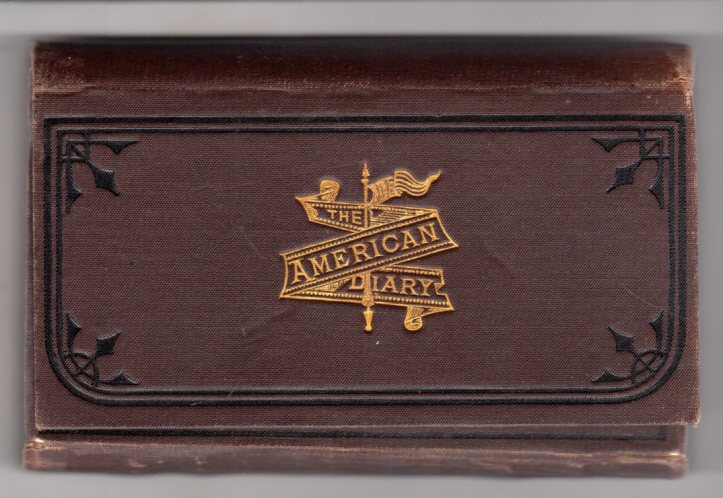
1894 SECOND TRIP
“July 14th, Eva Frost, John Powers and I sailed for Rotterdam on S. S. Werkendam, at 1 p.m. Day very hot but pleasant. Ride down the bay was charming, with cool breeze. Found large basket of fruit in room and “Brave Little Holland” and “Cook’s Holland, Belgium and the Rhine” all from Mr. Putnam. Before dinner sick! No sea, severe thunder shower at night.” (Sea still rough, spends a good deal of time outside on the deck)

“July 17th, All well. Went into saloon to dinner. Dense fog all day. John and Eva read aloud “Ideala.” Read some “Brave Little Holland.” Commenced “The Daughter of Today.” No sea. Cool.”
“July 19th, Fog dispelled at short intervals. No sea. Cold. In evening sat in saloon to write and came on deck just in time to see moon rise. Wonderful cloud effects, with occasional glimpse of moon. Just as dinner bell rang passed near by on starboard, large bark, careening toward us so we saw almost entire deck. We had all been watching for a long time, with and without glasses, a large iceberg, off our port. Exciting! Under good Dr. Van Schott’s guide, went down through steerage way to stern to see steam steering gear. Dr. S. most interesting man aboard. German, of wide study and thought.”
“July 21st, Remarkably smooth sea. Very cold, clear. A marvelous cloud effect following fine sunset. Heavy dark clouds hung low, to the very sea, which seemed a wooded shore of a small lake. Moon above the whole making a silver path on the sea. Could not dispel impression of an Adirondack lake. We enjoyed reading “Pembroke.”
“July 22nd, Slightly milder. Clearer. Services but we read “Pembroke” and didn’t attend. Don’t feel good – bilious. Tired of sea. Don’t like it!”
“July 25th, About 7 a.m. passed Silly Islands. Soon after the Lizard and then for some time feasted eyes on England’s shore. Beautiful. About 3 passed Eddystone. Saw fine ships and craft. Cold and rough in channel. Later on all seemed sea gain, but smooth.”
“July 26th, When I came on deck John told me I had missed fine chalk cliffs on English coast. About 10 Northern coast of France came to view – a glorious picture. As we neared Boulogne it was a charming sight.
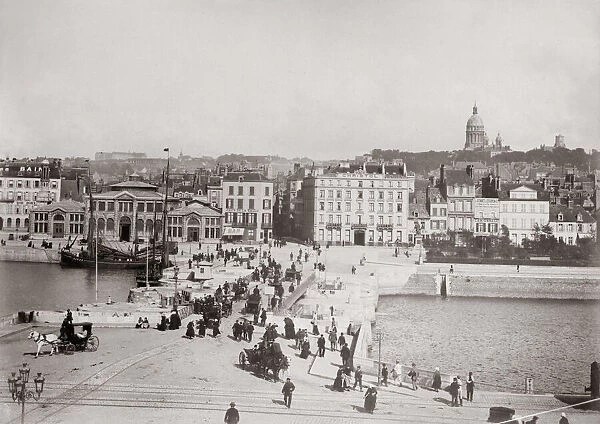
Weather balmy and just enough clouds for beauty. Water in bands of vivid green and blue. The city lay in just enough mist to add to effect. Prismatic colors from over land way tout to sea. Marvelous! Small steamer “Chicago” came out to us – water so smooth we did not have to cast anchor. About ½ our passengers left. For miles the French coast lay before us an “impressionist picture,” one charm following another. At Boulogne took on board Director General of Line and his party. Also fresh fish, red and white currents, and plums. Feasted! Made big effort to reach Rotterdam in time to land that night but got stuck on bar and tug took us off in a.m. Glad to have sail up, the Maas by daylight, fine. As we entered the breakwater never dreamed of such glory of phosphorescence, vivid green and rings all over the water. Revenue cutter’s bow in a mass of it as she brought Custom officers to us. He brought me a letter from Howard. Anabel and Marion and Aunt Nell. How happy to get them!”
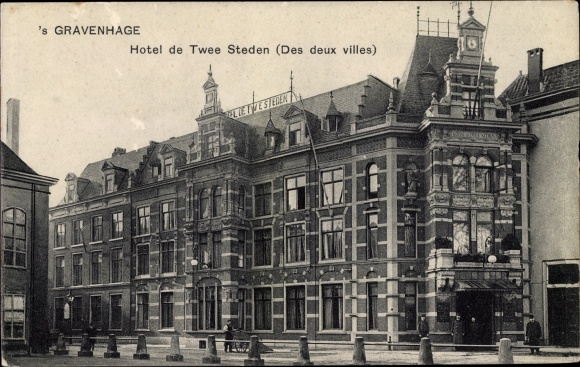
“July 27th, Landed at Rotterdam between 10 and 11 a.m. Fine weather. Drove to office of Co. and reserved 2 berths on Spaarndam for Aug. 29. Cabled Burt (Her son Albert). About 12 took train for the Hague. Stopped at Twee Steden or Trois Villes, a charming hotel…
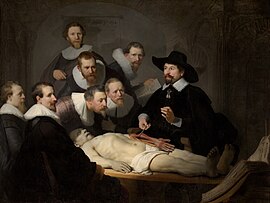
“Had a fine dinner and went at once to Art Gallery. Saw fine Rembrandt’s – School of Anatomy and Portrait of Grand Duke of Saxony…..
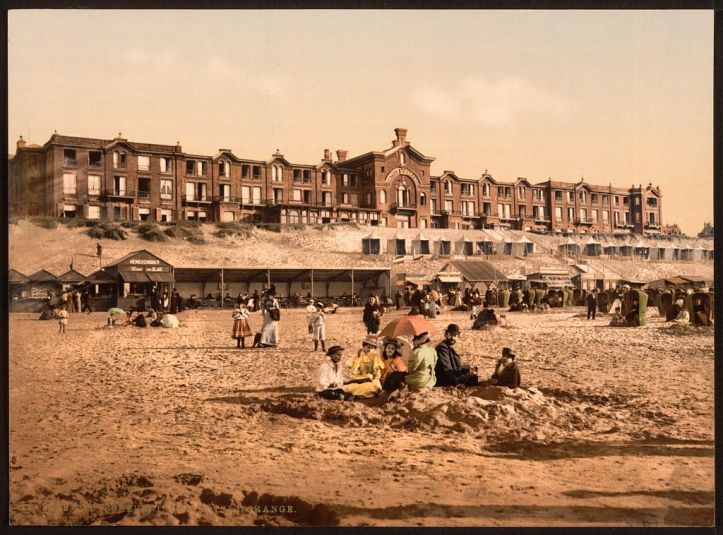
“Took carriage for one hour drive but couldn’t make driver understand and he took us to suburbs which made full 2 hours. Lunched and started at once for Scheveningue where we saw fine German audience and hear Royal Berlin orchestra. Grand beyond anything I ever heard of its kind. The resort very interesting and hotel, or whatever it is called, very fine.”
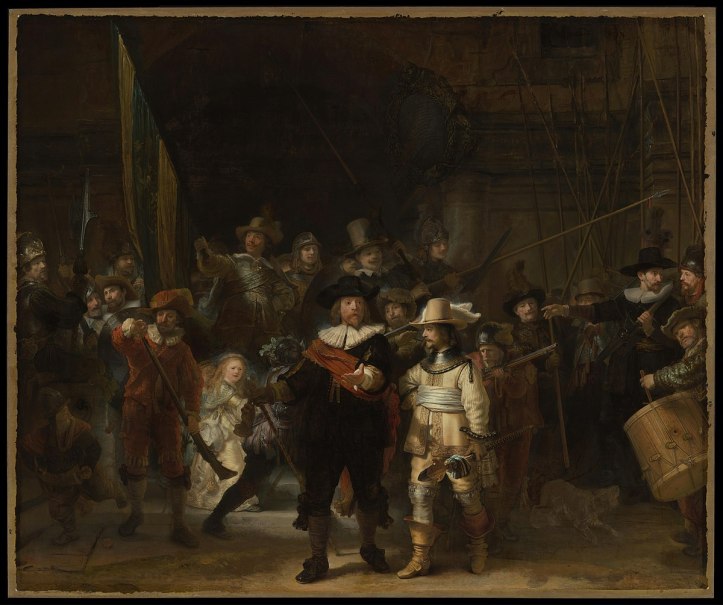
“July 28th, At 9 a.m. took train for Amsterdam. Weather fine. Stopped at Bible House, nice place. Had dinner and went to Museum. Finest painting ever saw. Rembrandt “Night Watch,” portraits &c. One of an old Dutch woman simply magnificent. Splendid, Van Dycks, Steen and Hals. Eva gave out and went home. John and I kept on until turned out. After supper we took open car and had fine view of city. After that a stroll through little narrow streets. City very quaint and clean. Fine bronze statue of Rembrandt in park.”
“July 29th, 8:45 a.m. took train for Cologne, arriving at 3 p.m. Weather fine. Stopped at Dom Hof, best place yet. The fine new hotel and new station broke up many associations of two years ago. Visited Cathedral. After dinner took open car rides to see city and went into Cathedral again about 8. Services both times. Singing at last service by all the people most impressive in the dim light!”
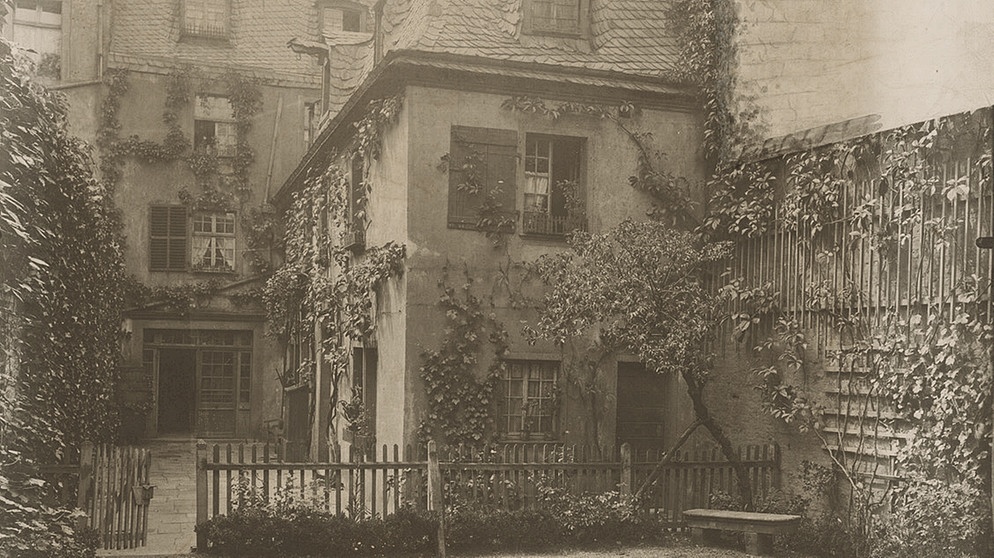
“July 30th, At 9:45 took train for Bonn where we went on board boat and spent all day and until 10 p.m. sailing up the Rhine to Mayence (Mainz). Day perfect, trifle cool. Can never forget the glory of nature to ruins of man’s work. Stopped at Holland Hotel, a nice place. Our ride at Bonn from cars to boat went past University and by beautiful parts of city. Saw house where Beethoven lived and fine bronze statue of him in a park.”
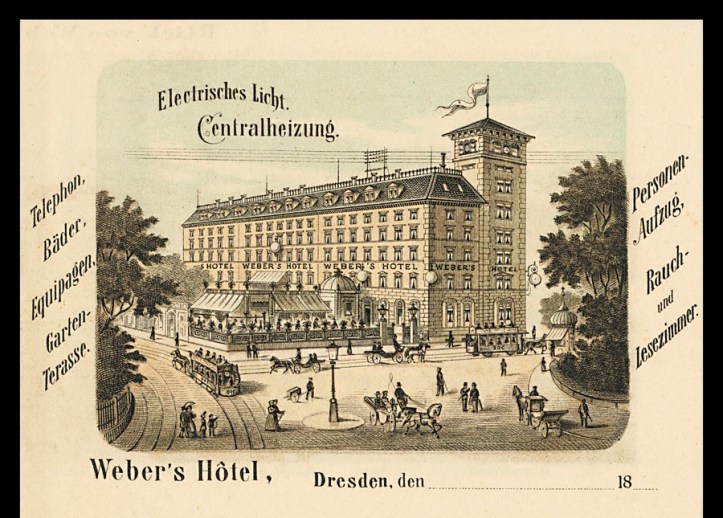
“July 31st, At 8:16 took train for Dresden. Weather glorious. John left us at Frankfort to go to Bayreuth. Told us to change cars at Eisenach. Mistake. Changed at Cob-beda (?) in pouring rain. Again at Leipsic (Leipzig). Couldn’t made guard or porter understand and owe success to a fine looking porter who simply walked in car and took our luggage and beckoned us to follow. We did as far full half a mile in rain to another station. There a pretty German girl, who spoke good English, helped us some. She gave us sandwiches and wine, the second one who came to our rescue. Couldn’t buy anything anywhere. Arrived at Dresden 9:30 and took carriage to Weber Hotel as Howard directed. Had dinner in room. Eva too wet to go down (got into bed at once at she had been sick all day.)
“August 1st, Awoke late with headache so decided not to hurry on to Schreiberhau by 10:30 a.m. train. Next one would get us to Petersdorf at 9 p.m. Strangers in foreign land. Drove to Dresdener Bank and got letter from Howard. Then to Museum. Saw Sistine Madonna!!! Also marvels of Florentine School. Stood it as long as head would allow and came home to bed. Rested, went back to see pictures but Museum was closed. Took nice walk alone around and beyond Museum. After dinner fine drive of an hour. Weather glorious.”
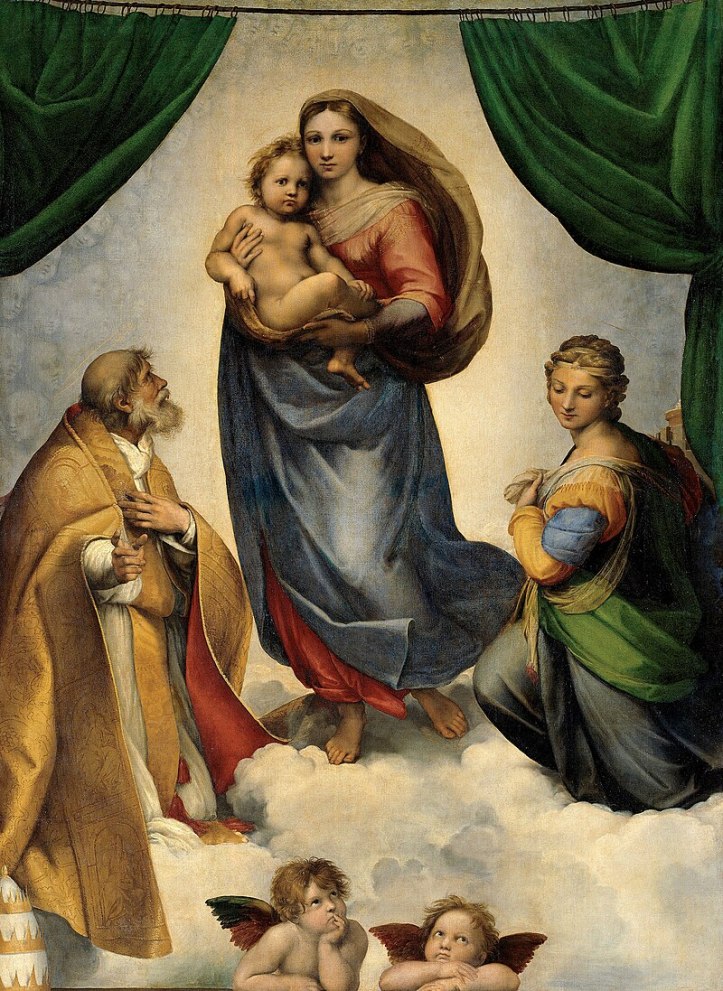
“August 2nd, At 10:20 took train for Schreiberhau. Could get ticket and check baggage only to Hirschberg. Had to buy tickets and check bag from there to Petersdorf where Howard and Anabel met us. How fine they looked!!! They had a carriage engaged and we were at once on our way up and up. A rushing stream on one side of road with high rocky banks, and on the other cultivated fields and high hills, sides partly wooded and partly variously colored fields made it a most picturesque drive. Same cunning little houses everywhere. Arrived at our mountain top in neighborhood of our villa (“Wilhelm Hoehe” over door) and family met us. Got out and walked back with them. Supper ready. Oh what glory spreads out before our door!! Mountains &c., charming valleys. We have sitting room, balcony off and bedroom with two beds. Have maid to serve us and cook our meals. Eat them in our sitting room if we wish but mostly in the best room of house opposite, on the walls of which are thirty antlers, large and small. No one could have things more enjoyable. Weather glorious.”
“August 3rd, Anabel and her mama went to village market and Mabel, Frieda, little girls and I went along for the walk. Stopped on brow of hill and waited for them. What a lane! Banks of wild flowers of all colors on each side. Wild violets in profusion. What views! After dinner while family went up the hill into the woods where six of us lay in hammocks all p.m. until thunder showers threatened. Passed by us. At 6 a.m. Mr. Boise and Howard started for Hirschberg to get piano. I must hear his music.”
“August 4th, A cloudy windy day with some rain in a.m. Our mountains took on another glory, the peaks kissed by great white clouds, rising from them like ghosts. Perpetual change. Piano came, drawn on a cart by one horse, woman to assist. Women seem an important factor for work here! What music we had all day long! It seems to me our boy is a genius to compose such music. He played his Nocturne, orchestral ballade and part of symphony beside much more. It seems wonderful to me and all so strange that he is so gifted. Anabel sang his “May the Maiden” and “White Rose Lover” with great passion. In evening Howard read (Henry Esmond) to family, as is his wont and we listened. Just as we had to into bed John Powers came. Had given him up for the night. Magnificent sunset. Anabel came for us to see it before we finished supper.”

“August 5th, In morning all of us took another walk to get new views. Sat down where five valleys opened out to us. What quantities of wild violets in grain fields! After dinner all sat out on lawn back of house and listened to Howard reading “Pembroke.” Same in evening, in house until I left to write my children. Day simply glorious.”
“August 6th, A warm lovely day. Between 8 and 9 all of us (save Eva) started for a long walk to some falls. We carried our hammocks (Mrs. Boise and I) and when at the foot of steepest hill where fields were, right in a pine forest, we swung them and rested while Howard read “Pembroke” aloud. For full three miles our walk lay through pine forests. As we lay in our hammocks the wind sang in the tree tops making a charming music. The falls were very beautiful, water falling over such rocks and rushing down it’s narrow ravine, the bed of streams filled with enormous boulders. Very deep ravine with beautiful moss covered sides. We went way down to the stream and came out again into the woods. The mountain we had climbed was 3000 ft. high or more. Reached home in time for 1:30 dinner having walked full six miles. After dinner all went up to our woods and swung six hammocks. Had more reading. All went down and left Mrs. Boise and me alone wand we had a nice talk. I lay in my hammock and picked the blue berries on each side. They were so thick we walked on them everywhere.
“August 7th, Rested in a.m. and watched men play ball. After dinner all took hammocks and went up back of house in a white birch woods and read. It was a perfect fairy land. We hung them just in edge of woods from which we could see our mountains. The ground was all soft moss and pretty little plants and trees all looked like Carot. Howard hung his hammock high and read to us again. After a while he commenced gymnastics using his hammock as a crossbar. We didn’t start down until after 6. Must not forget the glory of the landscape in the new guise. Great silver lined clouds, a soft hazy atmosphere making our mountains so beautiful and way off to the left leaving Hirschberg and its valley in a pale blue haze. So wonderful! And then afterwards such a sunset. Howard’s sprained band was better so he made music for us all this evening. Oh, such happiness!!”
“August 8th, Showers in a.m. After dinner all (same Howard) walked to Schreiberhau and visited famous cut glass factory. (H. wrote English friend Green and went for butter). Factory located at foot of long hill through pine forest – we climbed, visiting falls. Nice grounds and buildings. Beautiful stream rushing through grounds. Children and John explored cave in woods just before reaching factory. ‘Store full’ of beautiful things so cheap should have bought lots but for duty. Bought pitcher for Burt and Frances and dish for Howard and Anabel. Also some little blue John pottery at a wee store in S. Too tired to walk home after standing about so long so Mrs. Boise, Eva, Marion and I rode. Went through S. a beautiful little place and had a fine ride. Passed sisters house – a perfect picture. Wished I could sketch it. Roads so fine, white and macadamized, you would hardly know it had rained.”
“August 9th, Fun watching Howard play balls; Eva too. Rest had all gone up to highest point of mountains back of our house. I wrote letters all a.m. (Awful!) Cloudy day, making wonderful lights and shades. After dinner we went up to our white birch woods and hung hammocks. Mrs. B. and I read “Marcella” aloud. Wind blew and so cool Howard and Eva had to go down. Mabel also, later on. Mr.Boise came from S. up over the mountain and joined us and we had a nice talk. He is a great man, so broad in thought. In evening we all gathered about table and played Poetry game and writing cities of the world beginning with a certain letter.”
“August 10th, Mr. Boise, John, Frieda, Marion and Margaret left about 7 a.m. and walked to highest point of our mountains opposite. The rest (save Mrs. B.) went up to the little stones on mountain back of us. What views!! Came home by a bewitching lane across the dearest little stream and picked beautiful bouquet of wild flowers. What a lane, boulders scattered along its side which were gay with colors. After dinner sat out at our outdoor table and finished letter to Nettie, and commenced one to Jen, while Howard, Anabel, Mabel, Eva (and sometimes Mrs. Boise temped from her translating) played “Nonsense Poetry,” founded on name of a city. Our tramplers came in about 6:30 with big stories. Went to bed early with headache (too much cauliflower) and Anabel and H. sat by me in dark. Later caressed my head, rubbing.”
“August 11th, Took cold yesterday sitting out in grounds writing, while rest played Poetry game. Last one to go in. Before dinner right shoulder so lame couldn’t use my arm. Day cold and cloudy, rain in p.m. Got into bed to keep warm. Anabel and Howard spent evening with me, he reading “Ships that Pass in the Night.” Mrs. B. ironed my shoulder and rubbed with Liniment. No good. Awful pain!”
“August 12th, Shoulder worse. Howard went early to Schreiberhau for doctor. Rain and very cold. Howard read “Ships &c” to me. Kept in bed all day. Severe pain at times. Liked Doctor very much, his looks and actions. Couldn’t understand a word. Mrs. B. interpreter.”
“August 13th, Still raining and cold. Shoulder easier. Lay on lounge all day. Howard finished “Ships that Pass” &c. Wonderful book! He commenced Thelma for me. Doctor came. Our young folks could endure house no longer so rigged themselves for storm and walked to S. (full a mile) to a confectioner’s. Came home jolly and wet and reported great spree. Ice cream &c. No colds. Anabel and H. stayed evening with me, he reading. The rest played cards in sitting room below. Had to let my children’s letter go, writing made such pain. Wouldn’t let H. write for me and cause unnecessary anxiety. Can’t write now.”
“August 14th, Still raining and very cold. Shoulder so much better, went down to meals. Letters from Burt and Jen containing notice of Burt’s monument design for Syracuse (Hope he gets it!)”
“August 15th, White clouds seemed reluctant to leave our mountains and fairly hung like fleece to the forest tops. I watched them often and long, rising like spirits, from even way down in the valley below us. They finally settled, a snowy mass all along the summit of our mountains, where they hung all day, constantly changing as the sun marched on. Howard often pointed out where here and there they looked like snow crowned Alps – only lower – and where like the glaciers. They entertained us all day. The day proved very clear and beautiful. Shoulder better so joined my family at meals. Evening brought fresh entertainment. The moon rose right out of our cloud mountains and as she lighted them we had the illusion of mountains white with snow, moon shining on them. Wonderful! Howard continued reading “Thelma” – a sweet book. Unable to raise my arm, though shoulder easier.”
“August 16th, Day dawned cloudy and rather doubtful. Shoulder about same. After dinner Mrs. Boise and I walked to Schreiberhau to get my money from Berlin by P.O. Took carriage from there to Kochel Falls, where Mr. Boise, Howard and Anabel and little girls were awaiting us, having walked there from home. Falls beautiful but real charm was in the stream that dashing over the rocks and boulders joined the fine stream that runs along the road leading down to Petersdorf. As you leave the main stream the branch runs between high rocky banks that rise 100 feet or more, covered with beautiful trees – pine, birch, etc. The light of the sun flickering through them made it a veritable fairy-land. Can never forget our walk home across the hills and valleys right to Frau Kluge’s door, where I was ready for supper. Very tired and arm painful. Can’t use it yet though shoulder improving. The air so clear over mountains seemed coming to our very doors. The lights and shadows beautiful. Passed characteristic little homes here and there. Hope I will never forget all the charms of the walk home from Kochel Falls. “Thelma” in evening. Full moon I think.”

“August 18th, Howard, Anabel and I took walk from Kluge’s house across valley, down by little mill and home. Found Mabel who had just returned from a two days tour to the great Schneekoppe, which to us looks a pale blue cloud, mostly mist covered, highest of all our mountains. Howard played for us all evening. Day cold, dark and damp, scarcely a ray of sunshine. Started for a morning walk to store with Mrs. B. and Anabel but rain made me turn back. Can use arm better but unable to raise it. Decided it is best to go Monday to Berlin hoping to find dry weather. Letters from Burt, Nannie and Martha.” (Next day spent packing for the trip home)
“August 20th, Howard, Anabel and I left by carriage about 7 a.m. for Petersdorf where we took 8:13 train for Berlin. John and Eva rode down to P. with us. Weather cold and damp and dark. Magnificent scenery. Came down mountain by short steep road. Had car to ourselves all the way. Rain most of time. Read Thelma and had lovely time. Arrived Berlin 6 p.m. and drove to our pension 109 Karfustan Str. Delicious bread and tea daintily served in our room. Fine supper at 7:30. Went to 100 right after supper and spent evening alone – we three. The fine piano so enthused Howard. He played gloriously. His fingers seemed like little spirits flying here and there to make audible the depths of his soul. How he played his Variations and piano Ballads!”
“August 21st, We three went out right after breakfast and bought my flannels and Nannie’s watch. Stopped at famous old Conditorei (Konditorei or pastry shop) on Linden corner Friedreich Str. and ate. Visited Aquarium. Fine! Flirted with chimpanzee. Saw beautiful anemones, jelly fishes &c. all in their native element. Called at Linden office to see about train to Rotterdam. All this time arm pained so severely had to confess and Howard got off car on way home and ordered Doctor Thielen to call. Got into bed at once. Dr. ordered ice (found us trying very hot water). Ice instant relief and we had lovely times. Howard reading Aldrich’s short stories to us. Slept well. Anabel had to dress and undress me &c. Dear sweet girl! It is a pleasure to be sick to have such loving care.”
(The next day several of the family they saw in Schreiberhau came to visit. She says Anabel has to return home and she is very sorry for that. Her arm is better but “useless.”)
“August 23rd, John, Eva and Mr. Boise went sight seeing. Howard to bank. After dinner John, Eva, Howard, Anabel and I went to Howard’s room and he played to us. Saw kind Frau Klinghardt. Evening spent at 100. Howard and Mr. Boise played Im Walds, Die Meistersinger and Hoffman Duets. Arm in sling. Leeches applied in a.m. Howard and A. with me.”
“August 24th, In a.m. John, Eva, Mabel, Anabel, Howard and I visited museum. Saw many fine Rembrandt’s, Murillo’s &c. Rested after dinner, Howard reading to us &c. At 5 went to afternoon tea at Mrs. Boise’s. Apartment in living order and as tasteful and lovely as I ever saw. Mr. Boise and Howard played Schumann Symphonies. Anabel went to pension to supper with John and Howard. We stayed at 100. Anabel sang beautifully all evening. In p.m. sang Mr. Boise’s two songs. Lovely.” (The next several days is spent going to many of the shops in town. She and Mrs. Boise visit an “Antiquity” shop and she buys a pair of candlesticks for her corner cupboard at home. Every night is filled with musical events in their rooms)
“August 27th, Howard, Anabel and I went off after breakfast. Visited new Reichstag and Victory Monument. Bought tickets for Rotterdam. After dinner Howard read to Anabel and me for a time, then we went to his room where he played lots of his music to me for last time. Came home to supper and spent quiet evening at Boise’s. John and Eva off alone. Arm bad again. Day damp and muggy.”

“August 28th, Glorious, bright, cool day. John, Eva and I left Zoo Station at 12:05, noon, for Rotterdam. Can never forget the dear group that saw us off – entire family save Katharine. Howard and Anabel ran to end of platform and I looked at them as long as possible. Arrived at Rotterdam 12 night, their time. Fine vestibule train to Oberhausen. Changed there at 8, again at Emmerich 9:30; got out to have baggage examined at Zevenarr, changed again Utrecht. Arm comfortable but useless.”
“August 29th, Sailed on Spaarndam at noon. Day fine. Ship large, accommodations good. Warm. Arm same.”

“August 30th, Real warm and bright. Sea very smooth. At early hour discovered some of our companions going over had come on board at Boulogne in night. Among them Dr. Sneder, fiancee and her parents. Made bold to ask him to take charge of my arm on voyage. He fixed medicine for me at once. Found he was homeopathist!” (Next couple of days she just writes that her arm is improving and there is a heavy sea so she’s seasick.)
“September 3rd, Fine all day until about 5 p.m. commenced to be very rough. Not sick however. Awful night! Such pitching and rolling! Skylight near our room closed for first time.”
“September 4th, Heavy sea continues. Ship rolling and pitching fearfully. Dear Miss Libby came and washed me and helped me to dress and get on deck. Sick! So cold couldn’t stay on deck. Stayed in my room – most comfortable place. Stewardess brought me what little could eat. Another awful night, worse than last.”
“September 5th, Dear Miss Libby came and made me comfortable in a.m. Ship still plunging and as it was too cold to sit out remained in bed all day. She read George Eliot’s Clerical Tales to me and whiled away time. Beautiful girl! Sea smoother towards night.”
“September 6th, Off Banks. Fog horn for few hours. Rain. Couldn’t sit out on deck, so damp. Eva stayed in room with me a while before lunch and after, reading David Copperfield. Her cold is better and she is more like herself. Little trooper, not to be seasick when she was so ill with her cold &c.!! Sea somewhat rough.”
“September 7th, 18 years ago today!!! (Death of her husband). Fine mild day, very smooth sea. Passed Sable Island from which lots of beautiful little birds of different colors, came aboard. They were very tame – or tired – and alighted on our heads and laps. Many were caught. We fed them. Sailors said they would soon die.”
“September 8th, Birds all gone. Day mild. Sea smooth. Nice long talk out on bow with Dr.’s Ingraham, Wolcott and Mrs. Knight. Mr. Hudley with us. Very warm night. Rat ran over Eva in middle of night. Plucky little Miss only groaned gently and when I awoke she jumped out of bed and watched him run away on top of partition into next room. Took on pilot about 10 p.m. by our port.”
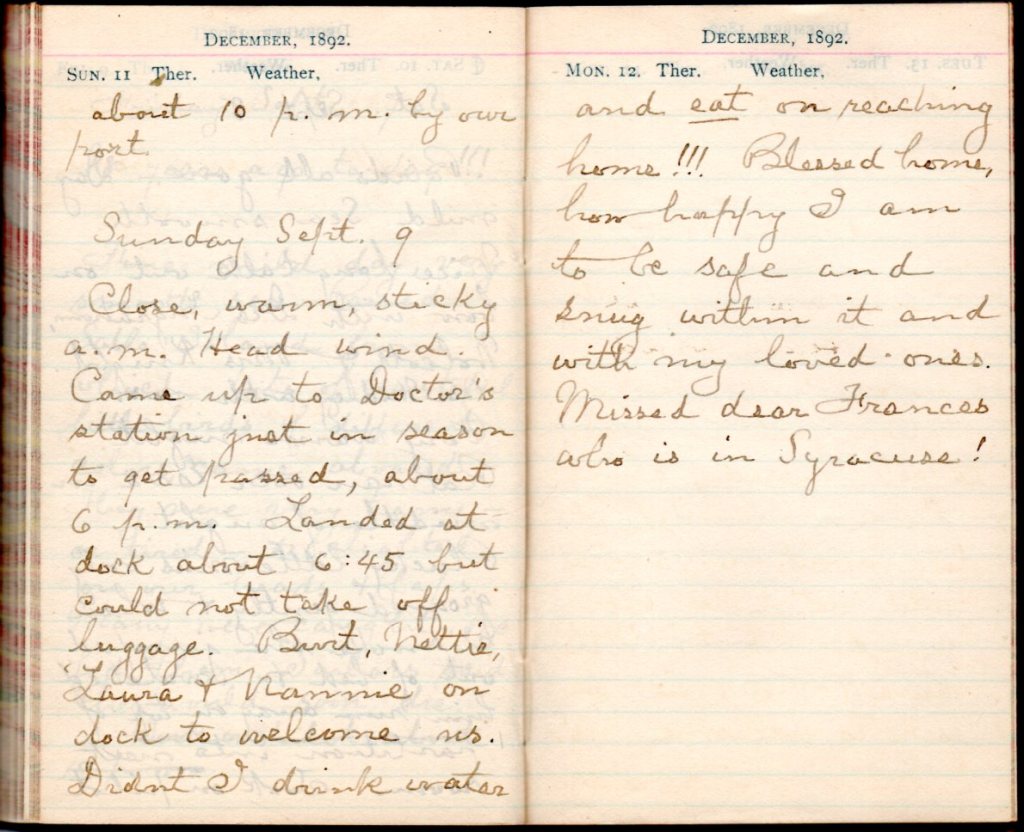
“September 9th, Close, warm, sticky a.m. Head wind. Came up to Doctor’s station just in to get passed, about 6 p.m. Landed at dock about 6:45 but could not take off luggage. Burt, Nettie, Laura and Nannie on dock to welcome us. Didn’t I drink water and eat on reaching home!!! Blessed home, how happy I am to be safe and snug within it and with my loved ones. Missed dear Frances who is in Syracuse!”
Das Ende
 Sallys Diaries Private Collection
Wonderful read, thank you for sharing this.
LikeLike
You are so special Kathi. Thank you. Hope you are doing well.
LikeLike